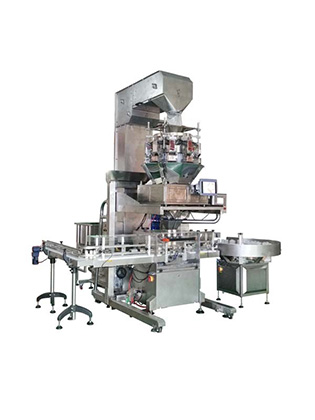
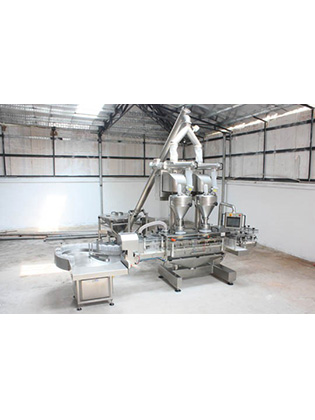
Automatic High Speed Injectable Powder Filling With Rubber Stoppering Machine

Technical Details :
| Model No. | SBPF-250 |
| No of Track | Two |
| No of Powder Wheel | Two |
| Production Rate | UP TO 120 Fills / Min. for SINGLE Dose UP TO 60 Fills / Min. for DOUBLE Dose UP TO 40 Fills / Min. for TRIPLE Dose UP TO 30 Fills / Min. for FOUR Dose |
| Fill Capacity | 5 gms. to 30 gms. - With TWO different powder wheel depending on neck diameter and powder characteristics |
| Accuracy | + 2% Depending upon the consistency, uniformity & bulk density of powder under the controlled level of humidity below 28% |
| Electrical Rating | 0.75 HP (1400 RPM) Motor |
| Power Requirement | 415 Volts, 3 phase (4 Wire System) 50 Hz |
| Conveyor Height | Adjustable from 800 mm. to 850 mm |
| Machine Dimension | 1270 mm. (L) x 600 mm. (W) x 1725 mm. (H) |
| Input Specification: | |
| Vial Diameter | 25 - 70mm |
| Vial Height | 33mm - 120mm |
Note: Dimensions & Technical Details are subject to change as per customers' requirement without any further notice
Automatic High-Speed Injectable Powder Filling with Rubber Stoppering Machine
Multipack Automatic High-Speed Injectable Powder Filling with Rubber Stoppering Machine is a pharmaceutical vial filling system designed for the controlled filling of sterile or injectable powders followed by automatic rubber stopper placement.
The machine combines powder dosing and rubber stoppering in a synchronized automated system, reducing manual handling and supporting efficient pharmaceutical vial processing. The final configuration should be engineered around the specific aseptic process, product characteristics, vial/stopper combination and applicable GMP requirements.
High-Speed Injectable Powder Filling Machine
The machine is designed for applications requiring controlled powder filling into vials followed by immediate stopper placement.
A typical process is:
Vial Infeed → Vial Positioning → Injectable Powder Filling → Rubber Stopper Feeding → Stopper Placement → Stoppered Vial Discharge
The system can subsequently be connected to aluminium cap feeding, crimping, inspection, labeling and cartoning equipment.
Injectable Powder Filling Technology
The powder dosing system is selected according to the product’s:
- Filling weight
- Bulk density
- Flowability
- Particle size
- Electrostatic characteristics
- Hygroscopicity
- Required filling tolerance
- Production speed
For low-dose or difficult-flowing injectable powders, the dosing system should be established through product trials and process qualification.
Automatic Rubber Stoppering
Following powder filling, rubber stoppers are automatically fed and positioned onto the vial.
The stoppering system can include:
- Automatic rubber stopper feeding
- Stopper orientation
- Controlled stopper placement
- Vial presence detection
- Stopper presence monitoring
- Reject arrangement for missing/incorrect stoppers
- Controlled transfer to downstream capping
The exact stoppering configuration depends on the vial and stopper specifications.
Key Features
- Automatic injectable powder filling
- High-speed rotary/intermittent-motion configuration
- Integrated rubber stoppering
- Controlled powder dosing
- Automatic vial handling
- PLC + HMI control
- No Vial – No Fill
- Vial presence detection
- Stopper presence monitoring
- SS316/SS316L product-contact construction
- Hygienic pharmaceutical design
- Servo-controlled mechanisms where required
- Automatic reject system
- Recipe and parameter management
- Suitable for integration with downstream crimping and inspection
Pharmaceutical Applications
Suitable applications may include:
- Sterile injectable powders
- Dry powder injectable formulations
- Antibiotic powder products
- Pharmaceutical vial products
- Specialty sterile powder formulations
For sterile injectable products, the machine alone does not establish sterility. Aseptic filling requires an appropriately designed controlled environment and validated sterilization, cleaning, transfer and processing procedures.
Technical Specifications
| Parameter | Specification |
|---|---|
| Machine Type | Automatic Injectable Powder Filling & Stoppering Machine |
| Application | Injectable / Sterile Powder |
| Container | Pharmaceutical Vials |
| Filling System | Product-Specific Powder Dosing |
| Stoppering | Automatic Rubber Stoppering |
| Operation | Automatic |
| Control | PLC + HMI |
| Product Contact | SS316/SS316L |
| Vial Handling | Automatic |
| Filling Range | Application dependent |
| Production Speed | Application dependent |
| Filling Accuracy | Product and dosing-system dependent |
| Stopper Size | Customer specification |
| Vial Size | Customer specification |
| Reject System | Available |
| Change Parts | Available |
Final filling speed, accuracy and machine configuration must be confirmed based on the product, vial size, dose, stopper specification and required production capacity.
Sterile Pharmaceutical Design
For sterile injectable applications, the machine can be engineered with features intended to support hygienic and aseptic processing, such as:
- SS316L product-contact components
- Smooth, cleanable product-contact surfaces
- Minimized product-retention areas
- Controlled vial transfer
- Automatic stopper handling
- Vial and stopper presence monitoring
- Safety interlocks
- Automated reject handling
- Suitable integration with isolator/RABS or other aseptic processing arrangements where required
The appropriate sterile architecture should be determined as part of the customer’s overall contamination-control strategy and GMP design.
Complete Injectable Powder Filling Line
Multipack can integrate the machine with downstream pharmaceutical equipment:
Vial Washing → Sterilization/Depyrogenation → Injectable Powder Filling → Rubber Stoppering → Aluminium Cap Feeding → Crimping → Inspection → Labeling → Serialization/Coding → Cartoning
The exact line configuration depends on the product and customer’s manufacturing process.
High-Speed Production
For commercial production, the machine can be configured with automated vial transfer and synchronized filling/stoppering mechanisms to minimize manual intervention.
Production capacity should be specified in vials per minute (VPM) after considering:
- Powder dose
- Vial dimensions
- Filling mechanism
- Number of filling stations
- Stoppering arrangement
- Product flow characteristics
- Required in-process controls
Why Choose Multipack?
Multipack manufactures and exports pharmaceutical powder filling machines, injectable powder fillers and integrated vial packaging systems.
The machine can be customized according to:
- Injectable product characteristics
- Filling dose
- Vial dimensions
- Rubber stopper specifications
- Required VPM
- Filling tolerance
- Aseptic processing concept
- Downstream crimping and inspection requirements